
Documents are often required to be certified, verified, notarized, translated, or formally declared before they can be submitted to a government authority, educational institution, employer, embassy, immigration authority, business organization, or another receiving institution.
In Nepal, a Notary Public performs authorized notarial acts relating to documents, copies, declarations, signatures, and other matters permitted under the applicable legal framework. The exact procedure depends on the type of document and the purpose for which it will be used.
This guide explains document notarization in Nepal from a practical client perspective. It covers what notarization means, common notarial services, the usual process, documents that may be required, and important considerations when documents are intended for use outside Nepal.
What Is Document Notarization in Nepal?
Document notarization is a formal notarial process carried out by an authorized Notary Public in relation to a document, copy, declaration, signature, or other permitted notarial matter.
Depending on the circumstances, the notary may examine the original document, verify a copy, witness or deal with a declaration, certify a document, or perform another appropriate notarial act.
Notarization is therefore not simply the placement of a stamp or seal on a document. The notarial act should correspond to the nature of the document and its intended use.
The legal framework governing notarial services in Nepal includes the Notary Public Act, 2063 (2007) and related rules and professional requirements. Because requirements can vary by document and purpose, applicants should confirm the procedure applicable to their particular situation.
Why Do Documents Need to Be Notarized?
Notarial services are commonly required when an organization or authority needs a document to be formally certified, verified, or accompanied by a declaration.
Requirements can arise in connection with education, employment, immigration, business, family matters, property-related transactions, legal proceedings, and documents intended for use outside Nepal.
The important point is that not every document requires the same procedure. The requirement should be determined by the document, its purpose, and the authority or organization that will receive it.
If you are unsure whether your document requires notarization, certification, copy verification, or translation, you can review the KIPLAN Notary services or contact the office for guidance based on your document and its intended purpose.
Common Document Notarization and Notarial Services
1. Document Certification
Document certification may be required when an institution or authority asks for a formally certified document. The notary examines the document and performs the appropriate certification act.
The exact requirements depend on the document and its intended use. Applicants should therefore confirm what the receiving organization requires before completing the process.
2. Copy Verification
In some situations, an applicant may be required to submit a certified or verified copy instead of an original document. Copy verification involves examining the copy against the document presented for verification.
This may be relevant to academic certificates, identification documents, professional records, certificates, and other official documents.
3. Sworn Documents and Declarations
Some matters require a person to make a formal declaration or sworn statement. Where permitted, a Notary Public may perform the appropriate notarial act relating to such a document.
The wording and supporting documents can vary depending on the purpose. Applicants should identify the requirements of the receiving authority before preparing the declaration.
4. Official Document Translation
Documents prepared in Nepali or another language may need to be translated before they can be submitted to an institution or authority using a different language.
Translation requirements vary according to the receiving institution and the purpose of the document. Translation and certification requirements should therefore be considered together.
For more information about submitting documents for translation, visit the KIPLAN Notary translation service.
5. Marriage-Related Documents
Marriage certificates and related documents are frequently required for immigration, visa applications, employment, education, and other official purposes.
Depending on the destination and receiving authority, marriage documents may require translation, certification, or additional supporting procedures.
6. Other Notarial Services
Notarial requirements can arise in many situations involving personal, academic, professional, commercial, and legal documents. The appropriate procedure depends on the nature of the document and its intended use.
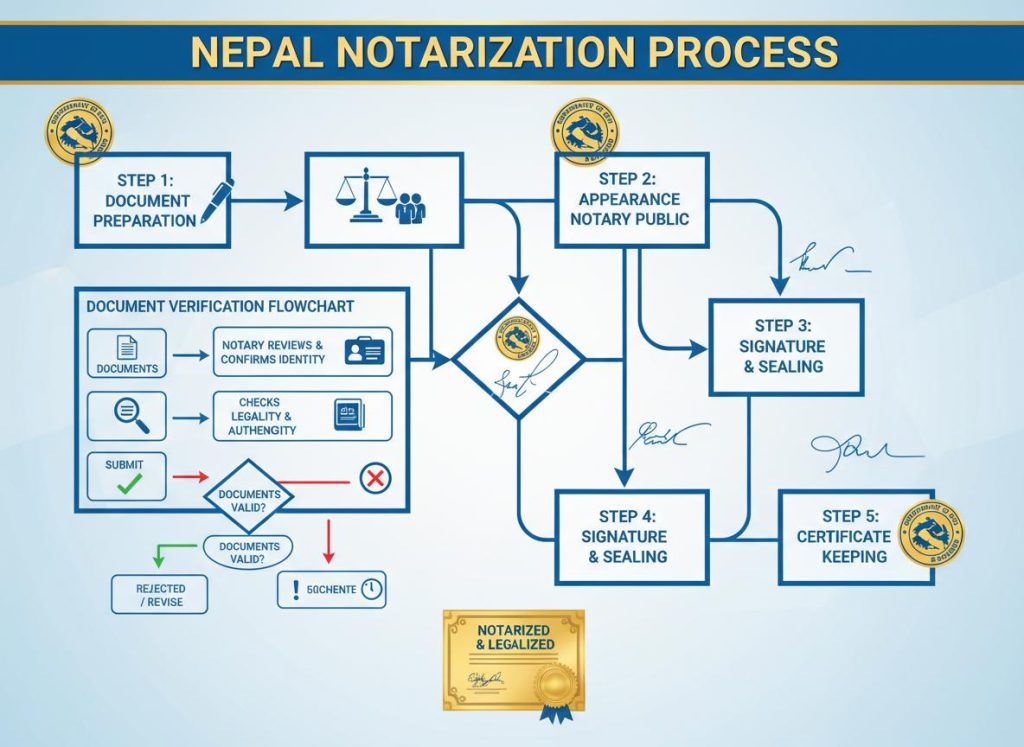
What Is the Document Notarization Process?
Step 1: Identify the Required Service
First, determine what the receiving authority actually requires. The requirement may be certification, copy verification, a sworn document, translation, or another notarial service.
Step 2: Prepare the Relevant Documents
Bring the relevant original document and identification where applicable. Additional supporting documents may be required depending on the service and circumstances.
Step 3: Document Examination
The document is examined to determine the appropriate notarial procedure and whether the information and supporting materials are sufficient for the requested service.
Step 4: Notarial Act
The Notary Public performs the appropriate authorized notarial act in accordance with the applicable requirements.
Step 5: Completion and Delivery
Once the required procedure has been completed, the applicant receives the relevant document or completed notarial service for its intended use.
What Documents May Require Notarization?
The documents that require notarial services vary depending on the purpose and receiving authority. Common examples may include academic certificates, identification documents, marriage certificates, declarations, agreements, professional documents, and documents intended for use outside Nepal.
This does not mean that every document in these categories automatically requires notarization. The receiving institution's requirements should always be checked.
Documents Intended for Use Outside Nepal
Documents intended for use outside Nepal may involve several different procedures. Depending on the destination country and receiving authority, an applicant may need document verification, notarial certification, certified translation, government attestation, authentication, legalization, or more than one of these.
These processes should not be treated as interchangeable. Notarial certification is a notarial act, certified translation concerns the conversion of a document into another language with the required certification, while attestation or authentication may involve a government authority or another designated institution.
For example, a student preparing academic documents for admission or scholarship applications may be asked to provide translated certificates, verified academic records, or documents carrying a particular form of certification. The exact requirement depends on the university, embassy, destination country, programme, and type of document.
Applicants should therefore check the current instructions of the receiving university, embassy, immigration authority, government office, employer, or other relevant institution before arranging notarial or related services.
Notarization, Certification, and Copy Verification
These terms are sometimes used interchangeably in everyday conversation, but they can refer to different procedures depending on the document and its intended use.
Certification may involve formally certifying a document, while copy verification generally concerns confirming a copy against the document presented for examination. Notarization is the broader concept of an authorized notarial act performed in relation to a permitted matter.
Because the terminology can be confusing, applicants should explain the purpose of the document and identify the requirement of the receiving authority whenever possible.
Document Notarization Services in Kathmandu
If you are looking for document notarization in Kathmandu, the appropriate notarial procedure will depend on the type of document and the purpose for which it is required. Applicants may need document certification, copy verification, sworn documents, official translation, or another notarial service.
KIPLAN Notary provides professional notarial and document services in Kathmandu, Nepal, with a focus on accuracy, confidentiality, clear communication, and practical client support.
If you are unsure what service your document requires, you can contact KIPLAN Notary with the document details and its intended purpose.
Legal Framework for Notarial Services in Nepal
Notarial services in Nepal operate within the legal framework governing the notarial profession, including the Notary Public Act, 2063 (2007) and applicable rules and professional requirements.
The precise legal requirements can depend on the type of notarial act and the circumstances of the document. Applicants should therefore avoid assuming that one procedure applies to every document.
For general information about the role of a Notary Public in Nepal, you can also read our article What Does a Notary Public Do in Nepal?
What Should You Bring to a Notary?
The documents required depend on the service. In many situations, applicants should bring the original document, relevant copies, and identification where applicable.
If the document is intended for submission outside Nepal, information about the destination country and receiving authority can also be important.
If you are unsure what is required, providing the document details and intended purpose before visiting the office can help identify the appropriate procedure.
Things to Remember
- Not every document requires notarization. The requirement depends on the document, its purpose, and the receiving authority.
- Bring the original document and relevant copies when required.
- For documents intended for use outside Nepal, check whether translation, certification, attestation, authentication, or legalization is also required.
- Requirements of universities, embassies, government offices, employers, and other institutions may differ.
- Confirm the current requirements of the receiving authority before completing the notarial process.
Choosing a Notary Public in Nepal
When choosing a Notary Public, applicants should consider whether the notary is properly authorized, whether the service requested matches the document requirement, and whether the process is explained clearly.
For documents intended for international use, it is also important to understand whether additional translation, certification, authentication, or other procedures may be required.
If you need help identifying the appropriate service, start with the KIPLAN Notary services available in Kathmandu.
KIPLAN Notary
KIPLAN Notary provides professional notarial and document services in Kathmandu, Nepal, with an emphasis on accuracy, confidentiality, transparency, and practical client support.
Our services include official document translation, marriage law translation and certification, copy verification, sworn documents, document certification, and court marriage registration.
If you are unsure which service is appropriate for your document, you can provide the document details and its intended purpose so that the appropriate process can be identified.
To learn more about our available services, visit KIPLAN Notary Services. For direct assistance, visit our Contact page.
Related KIPLAN Notary Article
If you want to understand the wider role of a Notary Public in Nepal, read our related guide:
What Does a Notary Public Do in Nepal?Beyond Notarial Services
Mr. Kamal Khadka has also designed KIPLANScholar, an education and professional development platform created to support students, professional women, entrepreneurs, researchers, and others seeking educational, career, and professional opportunities.
Frequently Asked Questions
Need help with document notarization?
If you are unsure which notarial or document service you need, contact KIPLAN Notary and provide the document details and its intended purpose.
Important Note
This article is provided for general informational purposes. Notarial requirements can vary according to the document, transaction, receiving institution, destination country, and applicable law. Information on this page should not be treated as a substitute for legal advice or a determination that a particular document will be accepted by a specific authority.